This was a stunning blast from the past, courtesy of Joel Griswold last night. He was a source in this 1979 cover story I wrote for the old Sunday magazine at the AJC. It’s well over 5,000 words, I think. Yes, that’s 5000 words on mannequins.
My few years under contract with the magazine were the best gig I ever had. Editor Nancy Smith encouraged me to write as many words about as many bizarre topics as I chose. She even paid me an ideas fee, since I couldn’t possibly write every story that came to mind.
There are very few places you can write anything of depth with a strong narrative these days. The death of what’s now called long-form writing began in the mid-80s with the advent of USA Today, whose founding editor, Ron Martin, became AJC editor around 1989. I remember Mr. Steve Murray, the theatre critic, telling me writing more than six inches became an exhautsting rarity there.
When everything turned into 750-word stories, journalism became uninteresting to me and that’s why I went back to school for a master’s and PhD in psychology — probably a mistake. I recently saw a list of the least financially rewarding degrees. Number 1 is journalism. Number 2 is psychology. I presume these are undergrad degrees, but I’m living proof of the list’s general accuracy.
As I’ve often said, I want a third career as a cat sitter. In seriousness, I’ve become weirdly fascinated with human relationships with other species — how they see us. I suspect they have more complex feelings than mannequins do, but then again, mannequins are like human rorschachs. How we see them from moment to moment is a reflection of our own changing perceptions.
Anyway, thanks to Joel for adding another memento to my nostalgic ruminations.
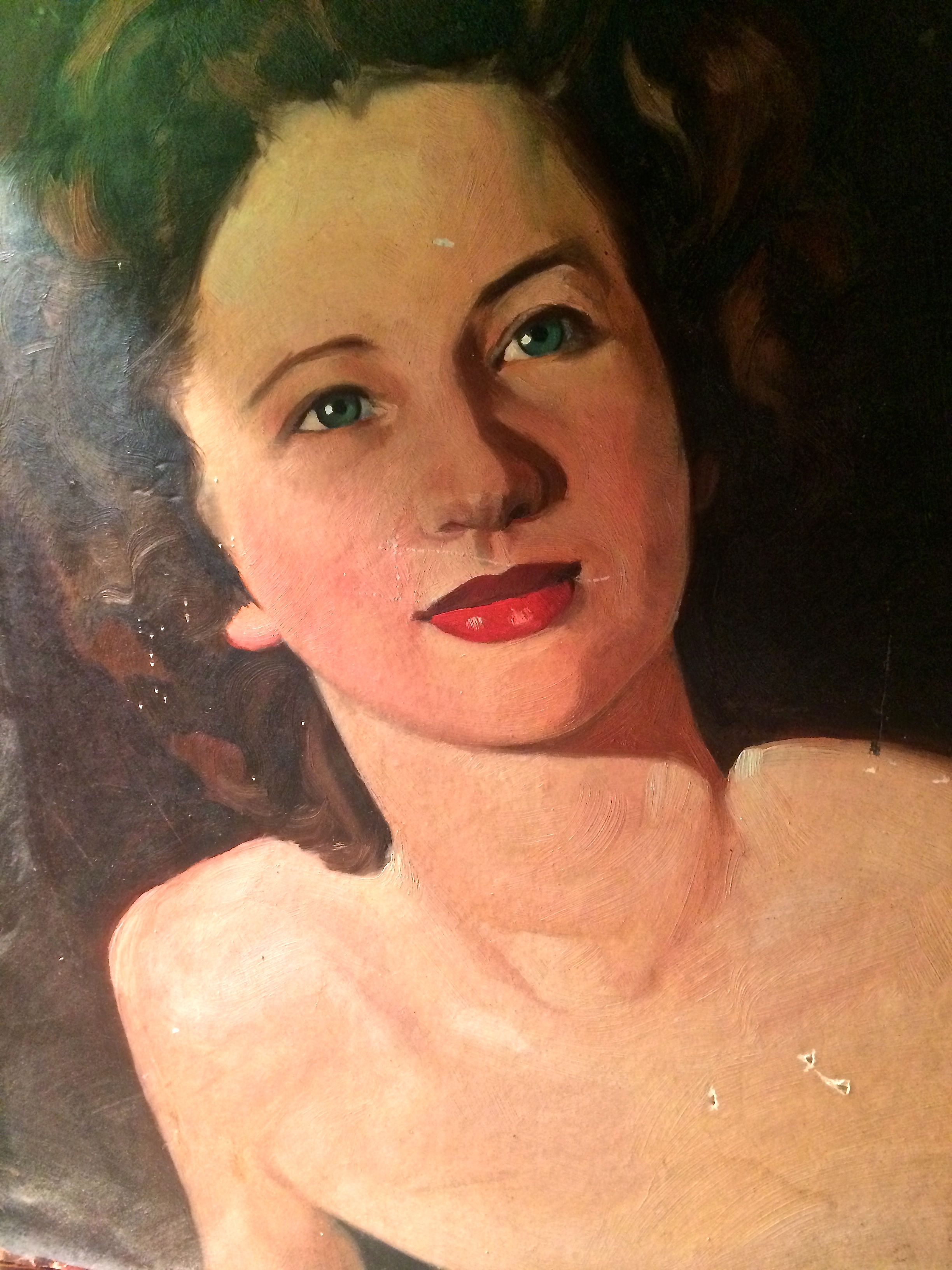
I grew up seeing it in the attic of every home we owned. Finally, maybe 30 years ago , I stole it. A day later, mama called and asked if I had taken it.
I confessed and she told me not to worry, that she just wanted to know where it was. Apart from feeling embarrassed, I wondered how it was that she noticed the painting’s absence so quickly. Did she regularly visit the attic to view it? Why didn’t she ever get a decent frame for it? Why was it always placed out of view?
At some point I asked her where it came from and she told me it was a self-portrait based on her high-school graduation picture. But a few years ago, I noticed some writing in the upper right corner: “R. Oster. Vienna, Austria. 1946.” She would have been 18 at the time.
My brain immediately concocted a story. Perhaps R. Oster was an Austrian boyfriend, a fellow art student, who lived in Charlotte during the war. Maybe, after the war ended, he returned to Vienna and painted this. Maybe Mama kept it out of sight as a memento of her first love in order not to make my father uncomfortable. Or maybe it was some kind of “mail-order art.” Maybe she visited Vienna and a street artist painted it.
I do know that by the time I stole it, Mama had bundled and hidden all of her art supplies and sketch books in the attic too. That made me sad and I asked her why she did that. “Because I’ve never been any good at art,” she said. I later found her artist’s notebook from the time she was about 15. (I‘ve written a lot about that before.) In that, she wrote about her ambivalence toward pursuing an artist’s life, even at that idealistic age.
It’s spooky to me that soon after I stole the painting and noticed mama’s tied-up art supplies, I developed a creative block that lasted for years. I often felt inadequate as a writer, as she did about her painting. Ultimately, I gave up writing as my primary occupation to study psychology, tired of the same financial insecurity that worried mama in her notebook. (But, no, psychology has never provided a good living, either!)
Ultimately, my mother called me the year before her stroke to tell me she had enrolled in an art class. She seemed very happy. I likewise have felt called to return to writing of more depth than the restaurant reviewing I’ve done for 30 years. (That is an understatement.)
Is the mysterious portrait something like “The Picture of Dorian Gray”? My theft occurred during a time of complete hedonism. God knows mama was no kind of hedonist, but she sure as hell liked material comfort. Did she sell her soul by abandoning her muse? Now that my youth has sped away, perhaps I, like her, am called to look back for inspiration. Memory can disappoint, but it also discloses how the arc of one’s life – one’s destiny – makes perfect sense.
I didn’t mention that the picture has spent the last 21 years in a room off my own attic. The irony of that never crossed my mind until now. I didn’t even think about its presence until a few days before my birthday on June 16 when I happened to enter the room in search of something else.
When I was a kid, I received almost weekly instruction from my mother never to get a tattoo. It was one of many things she deemed “hideous.” She most often issued the edict as we passed a trailer park on the way to her sister’s cabin on the Catawba River, not far from our home in Charlotte. “Only tattooed gypsies live in trailer parks,” she said.
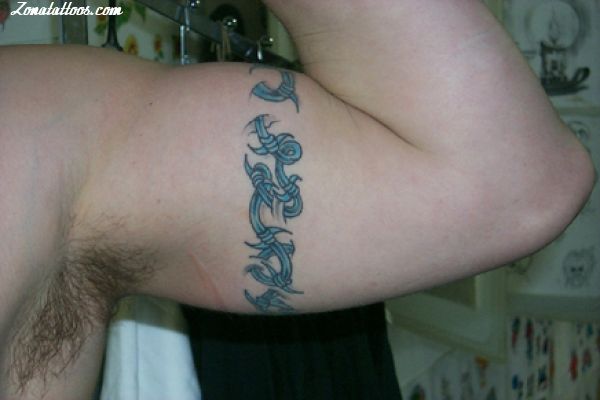
So, I was horrified when many of my friends began getting tattoos in the 1980s. I found the aesthetic, um, hideous. Why would anyone get a tattoo of a teddy bear in a cowboy hat and boots? What was up with the barbed wire encircling the biceps, the indecipherable tribal designs, and the ideograms? These were at least comfortable abstractions compared to many tattoos I’d seen in biker culture. I went to a tattoo “conference” once and saw a man with a bag of Cheetos tattooed on his back and the crucified Jesus on his shoulder.
Then one summer day in 2001, I browsed the Gay Pride market and came across a booth selling temporary tattoos. A friend talked me into getting a tribal/barbed wire armband. Walking around Piedmont Park afterward in my tank top, I noticed a lot of men smiling at me. When we went to Starbucks afterward, a very sexy stranger walked up, grabbed my arm and said, “That is so hot.” I had the same kind of experience the next day.
I found myself not washing the tattoo. It “worked” too well to give up. Eventually, it did of course fade. Then I began obsessing about getting a permanent one. I visited several tattoo shops to look at designs — I did not want the typical one — and found nothing appealing. Eventually, I decided I’d like an ouroboros, a classic alchemical symbol of a snake or dragon swallowing its tail (above right photo). No shop I visited had such a design, so it was my task to produce one an artist could trace.
I found an image and carried it to a shop in Little Five Points. I hemmed and hawed as I talked about putting this symbol of infinity and “wholeness” around my arm. I wanted it but I didn’t. Finally, the artist told me, “You need to go home and think this over. Wait a few days. If you still want it, come back.”
I decided to take his advice. On the way home, traveling through the Krog Street tunnel, I suddenly imagined myself dead in my coffin with a faded snake or some tribal cliche fencircling my arm.
Then I stopped at Carroll Street Cafe in Cabbagetown, where I ran into a lesbian activist friend I’d not seen in 20 years or more. She had a yoni tattooed on her shoulder. The yoni, at least in its tattoo form in the feminist ’70s, was a y-shaped image from antiquity that represented the vulva, a symbol of female power. Unfortunately, my old friend’s tattoo was barely decipherable. It looked something like a melanomic inkblot. Her skin was old, sagging, lined with fine wrinkles.
I was instantly cured of my desire to get tattooed. I could hear my mother sighing with deep relief.
What kind of anquish?
This memory came back while I read Dan Brooks’ engaging essay, “The Existential Anguish of the Tattoo,” in the Feb. 14 New York Times. It’s a great read, but it also annoyed me somewhat. A principal point is the way tattoos expressed rebellion in the youth of Brooks’ generation, then turned into emblems of conformity, eventually imposing a potentially embarrassing, constant reminder of values left behind. Oh. Did I mention Brooks is 36? His youth, apparently, is over. Oy.
He writes this:
Surely, my generation understands the transience of youth. We grew up watching nostalgic television shows about our parents’ childhoods, and so we know that the age of free love and nonmaterialism lasted approximately as long as their adolescence. Ask any 60-year-old what defined the baby boomers, and he’ll say their values; ask a 30-year-old what defined them, and she’ll say the way they abandoned those values as they aged.
***
Seen this way, our tattoos can read as an assertion of rebellion against what our parents did. Unlike them, we will carry the aesthetics of our youth into middle age, our hearts literally on our sleeves. If the boomers have taught us anything, it’s that the trappings of youth will embarrass you as you get older. We grasped that lesson only partly, and we have implemented it in the most ironic way imaginable.
Only someone still quite young could write this. For one thing, as I indicate, many boomers did get tattooed. True — they did not go to the extent of the succeeding generation’s sleeve-length, sometimes head-to-toe imagery. But, existentially speaking, that’s not the point, is it?
Brooks makes a common assumption that irritates the hell out of me. Most of my generation certainly did not participate in or adopt the values of progressive alternative culture (to my regret). This popular myth is an expression of the inevitable dissing by a younger generation of its parents’ generation. Boomers’ alternative values — the sexual revolution, the anti-war movement, the psychedelic fascination, the attraction to socialism — were all part of urban culture, in any case. They were not adopted by the majority of boomers.
Indeed, much of the contemporary young’s “identity branding” is, if anything, a radical adoption of the worst of overall money-obsessed boomer culture. And the extent of such inflation, including the tattooing, may express the desperation to be noticed. But, as with boomers wearing flowers in their hair, not everyone does that, right?
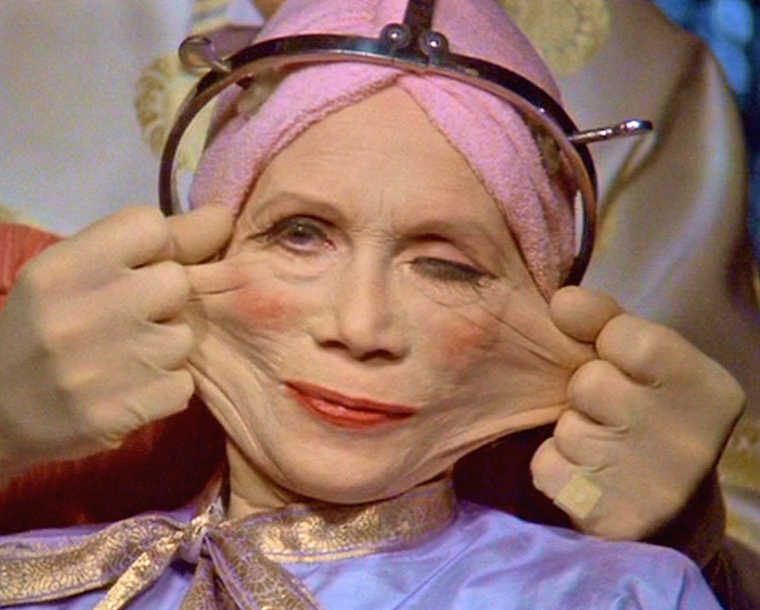
As for personal aesthetics, the, um, boom in “anti-aging” technologies is certainly an expression of the wish to hold onto youthful appearance and be noticed. People who get cosmetic surgery and botox treatments typically end up looking exactly like what they are: older people trying to look younger. It’s a painted but transparent mask. Short of actual surgery, I don’t believe most of these techniques cost more than tattooing a koi-fish pond on your ass — or erasing one. Tattoos and cosmetic surgery both fade and that actually highlights aging.
By the way, my mother the tattoo hater was one of those who subjected herself to the flesh’s alteration via cosmetic surgery. Repeatedly. After the healing was past and the effects were fresh, she did indeed look younger. But the effects faded. The followups, more radical surgeries, turned her into near-caricature to my eyes.
I could go on. I won’t. Just cease your boomerism and get off my lawn, Mr. Brooks! Your generation is no more aesthetically haunted than my own.
Here is comedian Lee Camp describing with absolute clarity in four minutes what is happening in America. I learned long ago that the only way to effectively undermine cruelty and willful stupidity is ridicule. You cannot reason with liars whose only interest is preserving their power.
Among those stupid and cruel people, alas, are the propagandists formerly known as journalists and commentators. I regularly torture myself by listening to the likes of Herman Cain, Rush Limbaugh, and Sean Hannity. The extent of their lying is breathtaking and tantalizing. It’s like attending one of those old-timey festivals of “tall tales.” I just can’t wait to see how big the next whopper is going to be.
Unfortunately, the right wing is not alone in this. “Neo-liberals” have become quite complicit, as the brilliant blogger Karen Garcia constantly points out. Change channels or turn newspaper pages and all you find is one layer of crap after another with rare exception.
Lee Camp brings to mind George Carlin and Lenny Bruce. Jon Stewart and Stephen Colbert are milder versions of the same style. Wouldn’t it be great if journalism schools began teaching satire?
PSYCHOLOGICAL LIFE begins in the imagination. That’s one reason I have a sign in my office, dangling from the mantel, that asks clients if they have a dream to share or if something unusual happened since their last session.
The latter — odd, sometimes surreal experiences — often communicate at great depth what is going on in a person’s life, conscious and unconscious. They essentially occur in an altered state when our repressed feelings — even the refusal to acknowledge our circumstances — demand expression. Such occurrences typically transcend hopelessness and often point to needed change. But they aren’t altogether without pain.
In the last few months, I have been in a dark night of the soul that is still too painful to describe in detail. Suffice it to say that it involves the loss of love — probably the most painful blow life delivers — and severe financial trouble.
My longtime friend and colleague Rose D’Agostino has been helping me with twice-weekly sessions. Rose works with energy and the way our psychological blocks are somatized. Like me, she believes the heart is an organ of perception. If you shut down its perceptual function, life loses much of its beauty and, as if suddenly blinded, you turn obsessively inward and feel hopelessly lonely, aimless.
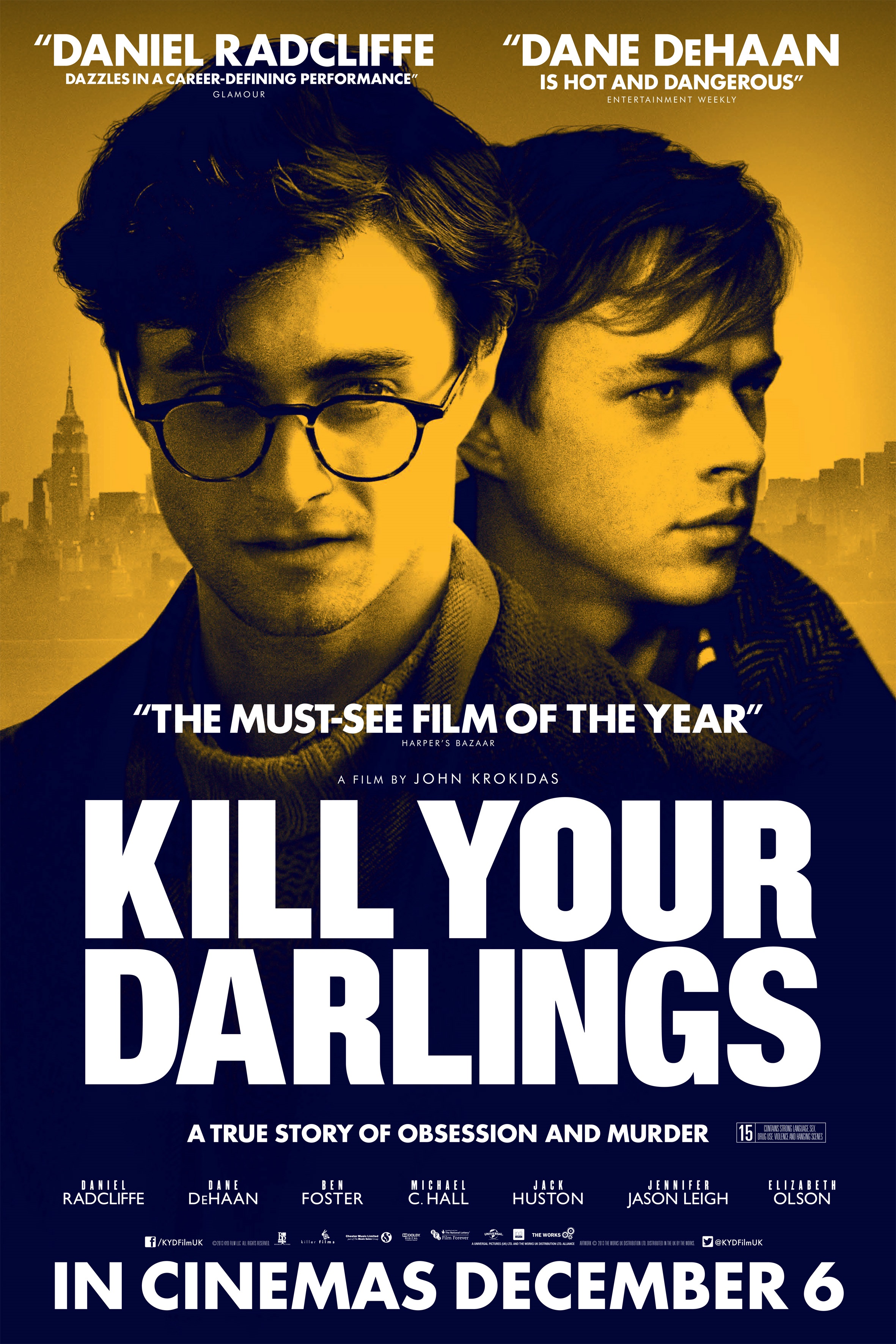
I left a recent session with Rose to meet my friend Frank to see the new film, “Kill Your Darlings.” I decided to stop at Rhodes Bakery to buy some of their famous cheese straws for us to eat during the movie.
WHEN I CAME OUT OF THE BAKERY, a pathetic guy in his early 20s — obviously a crack or meth addict — approached me and asked for money. I balked, as I usually do, then felt guilty, then gave him a dollar. I apologized that I couldn’t give him more and he laughed. “Don’t feel bad about that,” he said. I got in the car, tearful, wondering if I would have given him more money had I not just spent $7 I couldn’t afford to waste. Probably not. My priorities seemed pretty distorted.
I headed up Cheshire Bridge to Piedmont but found the intersection completely blocked by an accident. I made a u-turn and headed down a side street, which also turned out to be blocked. I made another turn and, before long, I was lost in Morningside, worried that I was going to be late to the theater.
I reached another intersection and couldn’t decide whether to turn right or left. Out the corner of my eye, I saw someone waving and yelling. It was an old man. He was bent over an elderly woman, his wife. She was lying in the grass next to the street and he was trying to help her get to her feet. I threw my car into park and joined them.
She was lying on her side, wearing a full-length blue coat and a faded pink scarf. As we lifted her, she smiled eerily, making no sound. Her husband took one of her arms and I took the other. We began a very slow walk up their inclined driveway to the front porch. As we walked, I rubbed her hand and startled myself by raising it to my mouth and kissing it. She squeezed my hand in return. I felt a tremor go through me.
We got her up the porch stairs to a chair where she sat smiling, still holding my hand. Her speech was very garbled — a stroke patient, I presumed. I was aware that she kept asking my name, squeezing my hand, looking me in the eyes, smiling. I felt like I was going to cry; my heart — my closed and broken heart — was aching. She was really old and her teeth were mainly gone, but I saw her as beautiful — odd, to say the least, since I hate every sign of my own aging. But beauty is what her gaze communicated — just like that of my sometime teacher, Mother Meera.
Her husband was clearly emotional, too, shaking my hand and thanking me over and over. I had the sense that he felt somewhat embarrassed too.
WHEN I HEADED DOWN THE DRIVEWAY, I realized that I was walking nearly as slowly as we had going up. I didn’t have a choice because my knees, ruined by a botched surgery, make descent so difficult. At that moment, lost on the streets in Morningside, walking in slow motion, I realized I was in a labyrinth.
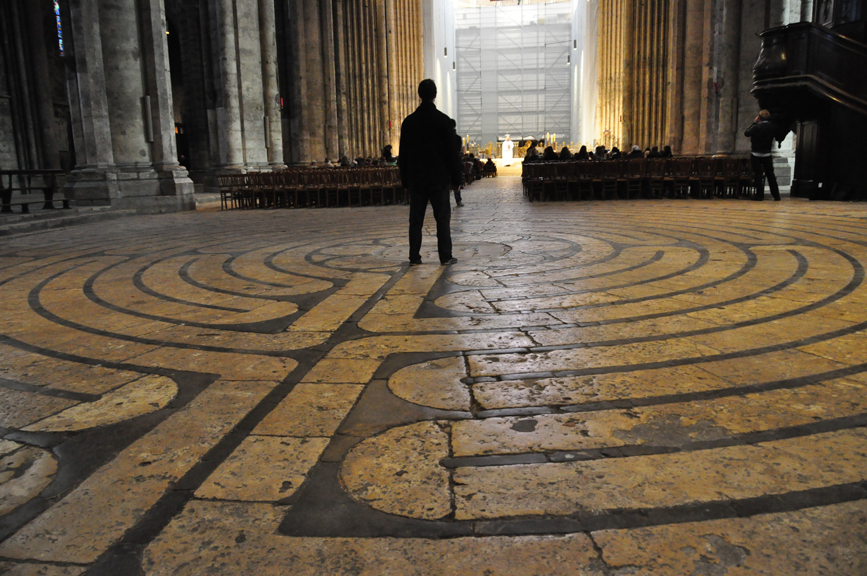
Labyrinths, like the one at Chartres Cathedral that Rose and I visited years ago (photo above), have been part of spiritual traditions since Greek and Roman times. In truth, their original function remains unknown, but they became tools of walking meditation and prayer, with the goal of entering higher consciousness or stillness at the center. (There’s one at the Cathedral of St. Philip in Atlanta.)
As I descended the driveway, I kept looking back at the couple on the porch and felt the radiance of gratitude. So much went through my mind, I could write a book about the experience. There was, first, the metaphor of the labyrinth and the reminder that opening the heart to suffering — my own, as well as others’ — is far less painful than trying to avoid its experience.
THERE WAS THE SENSE that the couple and the kid at the bakery both represented the path of compassion, something that has called me my entire life. Journalism appealed to me as a chance to “change the world,” as my mother sarcastically put it. But the industry turned into just the opposite — a heartless and often stupid defender of the status quo. I wanted out, or at least not to be wholly dependent for my living on it. When so many of my friends died during the early years of the AIDS epidemic, crying for the parents who had abandoned them, I went back to school for degrees in psychology.
My Morningside labyrinth also evoked the feeling of being set free. Among the perpetual agonies of recent years have been both guilt and anger with my deceased parents — guilt because I wish I had been more forgiving and helpful in their last years, anger because my father disinherited me while telling me how much he loved me. And before that, there had been years of fear that I might embarrass them, always reeling myself in before actualizing my soul’s yearning. Now, as I descended the hill to get in my car, the old couple smiled and waved at me, as if giving me permission to be myself. Was I really so awful? Did my fate always have to be the loss of love? Am I really too old to make something more of my life? And there was the old man’s embarrassment — the reluctance to ask for help that has been my own curse.
Finally, and perhaps most important, was the experience’s reaffirmation of the reality of the spiritual — something that greatly drained out of my life in recent years with one inexplicably painful experience after another. Rose had remarked on this during our session.
I SAY IT WAS SPIRITUAL because it seemed so full of synchronicity and grace — demonstrative of a level of existence outside immediate perception that can’t be apprehended without slowing down to become mindful of this very present moment. The remarkable thing in my experience is that I did not seek it. But life’s archetypal forces will at times corner us, slow us down and demand we look at what’s before us. For such moments to unfold fully, one must give the heart its precedence. The brain does not feel cheated, I promise.
I got in my car, assuming I was too late to make the movie. I checked the time and was startled to see that only about 10 minutes had gone by. This is another aspect of such numinous experiences. An entire world, even one wrapped in narrative, can disclose itself within moments. It’s like a line of poetry or an image in a dream.
* * *
I FOUND MY WAY TO THE THEATER on time. The meaning of my experience was really just occurring. I tried to communicate it to Frank but such stories never seem to make a lot of sense in their immediate telling. Besides, I’d left the damn cheese straws in the car!
The movie turned out to be a perfect conclusion to my labyrinth “epiphany.”
“Kill Your Darlings” is about Allen Ginsberg when he was a student at Columbia, hanging out with others who founded the “Beat” movement — Jack Kerouac and William S. Burroughs.
Listening to them talk, I got very annoyed at first. It all sounded so over-the-top intellectual and ridiculously impassioned. Then I realized, with an embarrassed jolt, that it was just the way my friends and I at William & Mary talked freshman year, when we read poetry and conspired to create an “underground” paper on campus, “Iskra” (named after Lenin’s newspaper). While there, I created a tutorial program for poor kids, which in turn won me a teaching fellowship to Yale.
I REMEMBER WALKING INTO MY DORM SUITE at Yale, the first day. My three roommates were sitting in the living room having an impassioned discussion about T. S. Eliot’s poetry. I was shocked. I thought I was the only one with such exuberance for his work. But I was completely intimidated, listening to them. I uttered a few hoarse comments and they tried to draw me into the conversation, but I fled the room. One of them even chased me down, wanting to hear what I had to say.
I was, as had already become my life pattern, too overcome with fear to permit myself full expression. On top of being an anti-war, poetry-loving, intellectual socialist, I had come — like Ginsberg — to realize I was likely gay. I became terrified of my intellectual preoccupations, with my dawning sexual awareness, with my love of the strange — the things my parents always discouraged. I kicked aside the Yale fellowship and only spent one more semester at William and Mary. I moved home with my parents and absurdly undertook a life of comparative “normality,” even getting married for five years just before I finished at Georgia State University. I still feel ashamed when I run into someone from that period of my life.
Ultimately, I abandoned myself, sinking into the nihilism of depression and alcoholism. As I watched “Kill Your Darlings,” I compared myself and heard that inevitable, dark mantra of all depression — that I’d wasted my life. But I also thought of the couple on the steps of their home, thanking me so profusely for such a simple act. I felt some compassion for myself, remembering the freshman me, puffing on a hash pipe while writing poetry and listening to Ravi Shankar, yearning for love more than anything but unable — always, it seems — to sustain it, even to recognize its arrival and departure.
* * *
IF MY PSYCHOLOGY PRACTICE HAS A MOTTO, it’s from Gaston Bachelard, the French phenomenologist of the imagination, who wrote, “The psyche’s reality is lived in the death of the literal.” That’s another way of saying, as I stated at the start of this essay, that psychological life begins in the imagination. The soul and the spirit call us to enter what Henri Corbin (one of James Hillman’s main inspirations) called the mundus imaginalis — a world or state of mind between physical and spiritual reality described in esoteric Sufism. The psyche finds its way to spiritual reality through the help of angels, personifications of the mediator that arise in active imagination. (The Greeks believed essentially the same and understood their mediators, their gods, to be similarly evoked through imagination.)
I have no doubt that the young man outside the bakery and the elderly couple were angels of this sort. They arose during the reopening of my heart during my session with Rose to call me back to the terrain of soul and spirit and love. But they also reminded me that the journey is not a straight line. It twists and turns back on itself, demanding perseverance and patience.
(Jan 8: I’ve made a few edits for clarity here and there.)
His May 27 column, “Heroes of Uncertainty,” falls into that category. Inspired by the huge controversy over the new version of the American Psychiatric Association’s Diagnostic and Statistical Manual of Mental Disorders (DSM-V), Brooks makes the point that psychiatry is far from the empirical science we’d like to think it is. When it works, he observes, it is more like an art than a science. (All of this can also be said of clinical psychology and counseling in general.)
While it’s irritating to see Brooks writing without crediting the many others who have been making this point for years, I’m of course glad to see that the mainstream press is finally catching on. But, hello, Freud made the same point to the press in 1934.
This myth of therapy as science is precisely why, as I’ve explained a zillion times, I scrapped its practice to develop my own work. My greatest inspiration, James Hillman, made the point that the psyche, the soul, cannot be reduced to the brain’s anatomy. And — sorry, folks — the placebo effect is a huge part of the “science” of cognitive-behavioral therapy (CBT), just as it is with pharmaceuticals. CBT wears off as predictably as Paxil and requires frequent “booster shots.”
All of that said, I’m glad for real that Brooks wrote his column. A sample:
Psychiatric phenomena are notoriously protean in nature. Medicines seem to work but then stop. Because the mind is an irregular cosmos, psychiatry hasn’t been able to make the rapid progress that has become normal in physics and biology. As Martin Seligman, a past president of the American Psychological Association, put it in The Washington Post early this year, “I have found that drugs and therapy offer disappointingly little additional help for the mentally ill than they did 25 years ago — despite billions of dollars in funding.”
All of this is not to damn people in the mental health fields. On the contrary, they are heroes who alleviate the most elusive of all suffering, even though they are overmatched by the complexity and variability of the problems that confront them. I just wish they would portray themselves as they really are. Psychiatrists are not heroes of science. They are heroes of uncertainty, using improvisation, knowledge and artistry to improve people’s lives.
The field of psychiatry is better in practice than it is in theory. The best psychiatrists are not austerely technical, like the official handbook’s approach; they combine technical expertise with personal knowledge. They are daring adapters, perpetually adjusting in ways more imaginative than scientific rigor.
The best psychiatrists are not coming up with abstract rules that homogenize treatments. They are combining an awareness of common patterns with an acute attention to the specific circumstances of a unique human being. They certainly are not inventing new diseases in order to medicalize the moderate ailments of the worried well.
The question that always comes up for me is whether psychotherapy can be pulled out of its own delusions and evolve or, better said, return to its former understanding of itself. I tend to think not, believing that an altogether new discipline should be developed. But I give Brooks credit for being more compromising than me. In fact, Hillman was more compromising himself, despite his blistering critiques.
Around 1987, during my second stint as editor of Creative Loafing, I decided the paper needed an architecture critic. I’d returned to Atlanta after two years in Houston where I’d become fascinated with the subject. The magazine I edited there regularly ran architecture criticism.
So I put out the word and received a good bit of interest from some really forward-thinking architects. I asked most of the candidates to write the same essay – a critical review of John Portman’s Peachtree Center designs (c. 1967). The number willing to write that? Zero. It wasn’t because they liked Portman’s style. It was because they didn’t want to commit career suicide by hurling Portman’s reputation from the top balcony of the Hanging Gardens of Atlanta Hyatt Regency.
Atlanta generally is cursed with a lot of hideous architecture. The building booms of the ’60s and ’70s here destroyed much of the city’s outward beauty. And that wasn’t uncalculated, especially downtown. More about that in a moment.
* * *
One of the longtime blights upon our landscape – and increasingly around the world – is fast-food architecture. I was thinking about that one night last week when I decided to reward myself after not having what I thought was a heart attack (seriously) the day before. It was about 11 p.m., I think, and I needed a Toffee Coffee Arctic Swirl from Zesto to remind me of life’s sweetness. (Actually, any excuse will do.)
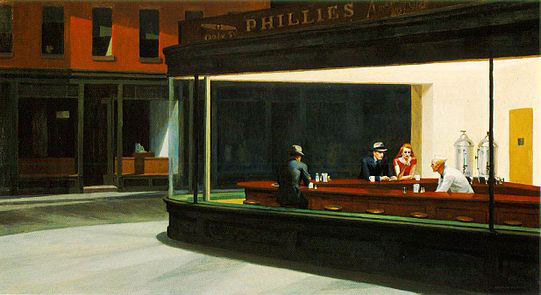
As I approach the Retro Zesto on Ponce (above) I notice how each window frames a view of separate tables. Somehow, that reminds me instantly of Edward Hopper’s painting, “Nighthawks” (1942) (left). I suppose the association is the nighttime view through windows of two diners. Of course, Zesto is actually flashy as hell looked at overall, whereas Hopper’s venue is non-descript.
Fast-food joints are flashy to catch attention, obviously, and we all know beauty doesn’t snare the American imagination as much as flagrant kitsch. Believe me, when those golden arches first appeared – as literal parts of McDonald’s architecture – they stabbed us in the salty gut and the hungry eyes. Obviously, too, the standardization of such design adds to recognition among the competing fast food emporia that snake along America’s highways. (Interestingly, though, Zesto has some seriously deviant designs that go beyond flashy to hilarious kitsch. Check out the Buckhead pagoda, if you haven’t.)
Besides catering to Americans’ low-grade aesthetics, fast-food architecture serves other purposes in my experience. Most fast-food restaurants conform to at least one standard of horror prevalent in Portman’s own architecture: elimination of the nooks and crannies of semi-private space that used to be part of architecture. I’m sure you can deduce why in the riot-plagued mid-’60s, Atlanta’s new downtown architecture was conceived to put everything in public view and provide no full-time residency. Thus we’ve never enjoyed the kind of downtown street life that characterizes larger, older American cities and most of the European continent.
In this context, there’s a little-acknowledged payoff in fast-food restaurants. As I near the door, my gaze meets that of others, each window a vaguely melancholy vignette. But when I get inside the harshly lit restaurant and join the short line, I’m immediately engaged in conversation with the interracial couple from New York in front of me. I’m proselytizing the curative powers of Toffee Coffee Arctic Swirls, which they decide to try and later tell me has changed their lives. “And we love the way the black is swirled with the white right here in Dixie,” the woman tells me, laughing.
I’m wearing my Pink Floyd t-shirt. As I walk to my table, three men with Bibles call me over and we start discussing the band. The shirt is illustrated with the band’s mascot pig and we get into a discussion about whether it’s a relevant image, as seems to happen every time I wear it. We start browsing our phones faster than Sunday School kids doing Bible drills.
Then a woman sitting alone at a nearby table shouts that Pink Floyd is her favorite band ever and that, yes, of course, the pig is the sine qua non of PF imagery. We high-five. The trio laughs and reopens their Bibles. One of them gives me what I assume is a business card.
I finally sit down with my ice cream. I look at the card. It says, “This entitles you to never-ending blessings from Jesus Christ.” Whoa! Bring on the cash, Big Guy.
A man and woman with an infant enter and take seats at a bar across from me. The baby is slapping its carrier and smiling between sips from a bottle. Four teenagers come in. Two are wrapped around one another like Siamese twins attached face-to-face and hip-to-hip. They break loose and walk toward my table. The guy stops.
“So you like that Kindle?” he asks in a deeply country accent. “How come you didn’t get an iPad?”
“For the same reason I’m eating at Zesto,” I say. He laughs. I ask where they’re from.
They are from Macon, up for a concert. I ask him if Len Berg’s, famous for its macaroon pie, is still open there. I used to stop there whenever convenient during the years I dined around the state for Georgia Trend magazine. He looked at me blankly. His girlfriend walked over and said, “Oh, my mama talks about that place! So does my grandma.” Thank you for making me feel decrepit.
One by one, everyone leaves the restaurant as others enter, many laughing as they walk through the doors. Bromides about ships passing in the night and conversations with strangers on airplanes go through my head. Outside, apparently homeless people mill about. One asks me if I have an extra French fry. “I’m out of those,” I say and give him a dollar.
* * *
It seems absurd to think that these overlit palaces of unhealthy, mainly bad-tasting food serve the purpose of public plazas. But they certainly are rooted in the tradition of roadside restaurants, diners and coffee shops where friends’ conversation overflows to strangers’ tables. Indeed, Starbucks — no matter how much you may hate it — serves that purpose big-time, especially with its newish community tables.
I spent two years soon after undergrad as editor of the McDuffie Progress in Thomson, Georgia, and I remember when the McDonald’s opened there, barely a block off the I-20 exit. It was a shock to the town, which had the usual spots where people gathered for morning coffee and cat-head biscuits. McDonald’s is not usually considered a hangout space, but I do remember lots of Thomson people commenting that the restaurant was, essentially, a landing pad for aliens — a good place for people-watching if not actual conversation.
But, if you think McDonald’s never functions as a community plaza, visit the one on Cheshire Bridge. At some hours, it’s full of mainly Mexican kids on laptops, taking advantage of the free WiFi. (And isn’t Facebook itself a public plaza?) The kids are often with their mothers. I got to practice my Spanish the couple times I went there to sample the repulsive McRib. “Como se dice ‘chicken finger’ en Español?”
My longtime socialist conscience has to note, though, that democracy is not at play in high-end restaurants or fast-food venues, for that matter. Most restaurants are vessels of classism. Maybe that’s true of all capitalist businesses, but I’m advocating transgression of social boundaries. That’s one reason I love small ethnic restaurants like those along Buford Highway. Their very alterity and low prices especially create a sense of the public plaza. They are typically as kitschy as fast-food chains, but at their best they are full of soul.
* * *
My parents lived in St. Simon’s and I had occasion once to visit John Portman’s home there, Entelechy 2. It was different from his weirdly hotel-like Atlanta home, Entelechy 1, but grotesquely Disneyesque to my eyes, and not mindful of its location. There’s no doubt the man is a brilliant rebel who has influenced architecture worldwide. But the cinematic scale displaces intimacy, perfect for anyone who wants to avoid the sight of poverty or open the eyes to the heart of diversity.
How utterly weird to think that trashy fast-food joints might constitute a homeopathic antidote to bland grandeur. Well, that’s the crazy way I think at Zesto late at night in the thrall of a Toffee Coffee Arctic Swirl after surviving a faux heart attack, anyway.
Oh, that “heart attack” turned out to be the result of an act of stupidity I committed in the gym.
Paul Krugman mentioned a lengthy Time magazine article — “Bitter Pill: Why Medical Bills are Killing Us” — in his column Monday. It’s by Steven Brill and describes in depth the utter piracy that has become the norm in the medical industry.
There’s no question that dealing with insurance companies is a nightmare for most people these days, but the real villains are the hospitals, Big Pharma, medical equipment makers, and greedy doctors that keep raising their prices well ahead of the inflation rate. Read the article.
Everyone has their stories. A few of mine:
I was “lucky” to learn what really motivates the do-no-harmers long ago. When I was 29, I landed in the emergency room at Piedmont Hospital, so sick I literally could not lift my head off the examination table. After an hour, the doctor who first examined me came in the room and announced, “You’re extremely ill. We don’t know what is wrong with you, but you have to leave because you have no insurance.”
Can you imagine? For years afterward, I dreamed that the assholes arrived on my doorstep dying of hunger. “I’m sorry, you’ll have to leave because you cannot pay for the food I have,” I’d tell them. Then, I began to choke as heavy winds blew hail and rain against my windows. The door flew open and the storm ceased. My breathing became easy. I took the doctors in and fed them.
No such humane stories occur in the real life of hospitals like Piedmont. After my parents gave the vultures $10,000, I was admitted and a doctor was assigned to my case. He couldn’t diagnose me and, after 3 days, I was near death. I’m not exaggerating. Only then, was an infectious-disease specialist called in. It took him about three minutes to diagnose Scarlet Fever. I was far sicker than I needed to be, thanks to the assigned doctor’s hubris.
Interestingly, weeks later, the specialist told me I would have been better off leaving Piedmont and going to Grady, Atlanta’s public hospital. At Grady, he told me, there is always a specialist in every field on duty in the ER. My Scarlet Fever would have been quickly diagnosed.
I was in Piedmont over a week. Maybe a month after I checked out, they turned me over to a collection agency whose lawyer threatened me repeatedly. Apparently, my parents had “underpaid” them $100 for my initial ER visit. I was dirt-poor but embarrassed to tell my father what was happening. So I sold some possessions and drove to the lawyer’s office to give him the cash before he threw me into small claims court.
Seven years ago, I had emergency surgery at Piedmont and they botched it. But here’s my favorite scene: Languishing in monstrous pain in the emergency room, completely unattended for hour after hour. I apparently blacked out after five hours and came-to screaming. At that point a doctor hurried over and I went off. I told her I was in the worst pain imaginable and that I couldn’t believe that they wouldn’t give me even aspirin to help deal with it. Her reaction? She burst into tears. I was mean to her. That’s okay, Doc., you go ahead and torture me by not addressing my pain and I’ll be nice.
And I loved this: Soon after I was admitted, someone thrust a paper in my face that said it was my responsibility to tell nurses to wash their hands (to avoid staph infection?) before touching me. Hello? I was on morphine and I thought my urine bottle was my cat half the time. I was supposed to tell the nurse,”Warsh yer hands, dammit!”
About a year ago, Kaiser referred me to an outside cardiologist on the Piedmont campus. Everyone promised that my tests would be covered under my ($700 monthly) insurance. However, because it turned out that the hospital owned the equipment the doctors used, I was charged $2000. Kaiser, refused to pay (but eventually did). I’m happy to say they no longer refer people to that practice. Meanwhile, I had to have all the tests redone at Kaiser’s own facility. Why? Because we couldn’t get all of the results from the Piedmont-campus doctors. “She just won’t give us the results,” the office manager said to me one day.
That our equally disgusting legislators enable this needlessly bloated and corrupt excuse for “free-market” medical care is particularly galling. (That reminds me, but I won’t get into my gall-bladder removal and the nurse who called me a wimp repeatedly at another, equally awful hospital.) There’s nothing free-market about this system. Congress won’t let Medicare negotiate drug prices, for example, thus raising taxpayers’ cost of the program by billions of dollars. Why? For no reason other than to protect the obscene profits of Big Pharma. Oh, those fiscal conservatives.
Obamacare is going to increase access to the system for lots of people, but it’s not going to do much to stop the increase in costs. In fact, the program is in many respects a huge score for the fat cats in scrubs.
Steven Brill’s article discloses several things new to me. One of them is the existence of something called “the chargemaster.” It’s a list of charges for everything a hospital does. Nobody Brill interviewed could give a coherent explanation of how the shockingly inflated prices are set.
Of course, insurance companies have the privilege of paying costs substantially below those on the chargemaster. But uninsured people or people who have exhausted their benefits are not told they have the freedom to do the same.
The most baffling thing of all is the way so many ordinary consumers do not support a single-payer system. Meanwhile, the national deficit that makes the same people so angry grows and grows and would be substantially reduced by a single-payer system.
Please read Brill’s article and pass it on to friends.
I’ve had a mind-blowing series of synchronicities in the last few days. I’m talking the kind of experiences that remind us that there is a world of “invisibles,” whether literal or imaginal, that can draw us toward the truth we are actively or unconsciously avoiding.
Synchronicities are acausal and nonlinear. I apologize if the telling of my story is equally circular:
I’ve been pretty seriously depressed for some time. There was the death of my mother. There was the death of my father, his disinheritance of me, and my brothers’ refusal to talk to me about it. A couple of longterm friendships crashed.
There was botched emergency surgery on my knees, leaving me broke and unable to run, bike or even walk downstairs comfortably. There was — there is — the loss of significant income from Creative Loafing’s cutback of my nearly 30-year-old dining column.
There’s my brother’s serious illness and my estrangement from him. (Estrangement and the refusal to discuss its causes drenches my family like a marinade of 500-proof liquor. And, yes, I most certainly include myself among the marinated.)
So, I’ve been pretty depressed and crazy at times. So much so that I decided to go to an AA meeting today, for the first time in 20 years. I thought picking up some of the program’s tools again might be helpful. Still, I sat in my car outside the AA clubhouse, Galano, for a bit, making excuses not to go in. Then I looked at my iPhone and noticed the date: April 9. I suddenly realized that this was the date I got sober 30 years ago. I seriously had no memory of this until that moment. Synchronicity. I didn’t dare not attend the meeting.
And there’s more…
I found the meeting quite soothing and a welcome reminder that I have dealt successfully with some major challenges over the years. I heard exactly what I needed to. But the small meeting at noon also made me anxious. Why had I quit going to meetings in the first place?
My memory — the start of another synchronicity — startled me again. At the time I originally arrived at AA, I was under contract to HarperCollins to write a book about what remained of the strange, Southern Gothic world of Flannery O’Connor. I was also cranking out cover stories about eccentric personalities for the Sunday magazine supplement of the AJC. I was living in a very strange world. And I loved it.
But getting sober rudely lifted me out of that world and in fact seemed to initiate writer’s block. I was frequently questioned by a “sponsor” — AA’ese for “mentor” — about my preoccupation with the weird. Who but a drunk would want to spend a month with a touring freak show? If I wanted to stay sober, my sponsor told me frequently, I might want to consider joining the “normal world.”
It sounds ridiculous, but, without questioning, I took this message so to heart that I walked to the Zesto near my house and, in a black depression, threw what I’d written of the book into the dumpster. This was the years of typewritten manuscripts. I had no copy. When I told my AA sponsor about this a few hours later, he raced over with a flashlight to retrieve the pages, but the dumpster had been emptied. He was horrified. I was actually relieved. And I do mean that.
When I have told this story over the years, I’ve always blamed the “shadow” side of AA, its supposedly normalizing dogma. But at the meeting I went to today, I realized that my action had very little to do with the imposition of any severe notion of normality that AA tries to foist on members. The group was reading from the foundational text, “The Big Book,” and much of it actually concerned the value of “crazy wisdom,” not a term AA uses, but one from the Dharmic traditions that certainly applies.
This was an embarrassing revelation but another awakening synchronicity: I happen to be (finally) writing a book about the virtue of being different, odd, eccentric, abnormal, whatever. In writing it, I’ve been reviewing my history with my mother. She was obsessed with making me normal throughout my childhood and adolescence. While she didn’t manage to achieve that, I did end up feeling guilty and afraid every time I’ve “stuck out in a crowd,” even if for flattering reasons. And I’ve usually run out of sight as quickly as possible.
Getting real…
That’s the real reason I abandoned my book project of 30 years ago. I did not want to appear crazy to my mother and the residents of her world. So, blaming a minor subtext of AA — and I seriously only got this today — was a convenient way of copping out of my book contract. The new, sober, normal me would not be embarrassing anyone, not even myself, no matter if it derailed my career. I do wish someone had intervened in this process, but I doubt I would have listened.
Now, I do believe AA promotes some behaviors that are superficially normalizing, like belief in a “higher power.” It doesn’t prescribe a certain concept of a higher power, but there’s a lot of pressure to believe. I understand that the idea is a strategic way of giving up a narcissistic perspective, but I’ve had many clients over the years bail for other support groups because of the “higher power thing.”
I also think my role as a writer preoccupied with the bizarre did make quite a few people uncomfortable in the early days of my sobriety. But, my God, that was equally true — more true — of the world at large. Above all, though, was my own discomfort with myself.
I should, however, give myself credit that during the 20-some years I wrote my weekly “Headcase” (nee “Paradigms”) column for CL, I did celebrate the beauty of the wacky. And I urged gay men to revel in their outlaw status for seven years in a biweekly column elsewhere. But with the end of those columns (and the onset of aging), I think I began retreating back to my wish to stay hidden. And that in turn reminds me that soul must have expression in order to flourish.
What do I make of this cluster of synchronicities? I think they ask me to move both backward, to what I learned of value 30 years ago, and forward, to appreciate and share the crazy wisdom I’ve accrued in my life as a paradoxically visible outsider.
We have a couple of spaces left. This is appropriate for Internet participants, as well as Atlantans. Official start date is March 26. Locals will be meeting the day before, Sunday.
I want to make clear that I’m not conducting this workshop, which is free. My friend Andrew Sutter is facilitating the group with me. It’s got me as anxious as anyone else.
Email me if you have questions or want to sign on. CliffBostock @ gmail.com.
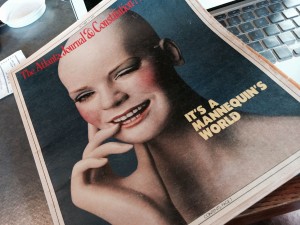 This was a stunning blast from the past, courtesy of Joel Griswold last night. He was a source in this 1979 cover story I wrote for the old Sunday magazine at the AJC. It’s well over 5,000 words, I think. Yes, that’s 5000 words on mannequins.